If Ever I See You Againroberta Flack
| If E'er I See You lot Once again | |
|---|---|
| Theatrical release poster | |
| Directed by | Joe Brooks |
| Written by | Joe Brooks Martin Davidson |
| Produced by | Joe Brooks |
| Starring | Joe Brooks Shelley Hack Jimmy Breslin Jerry Keller George Plimpton |
| Cinematography | Adam Holender |
| Edited past | Rick Shaine |
| Music by | Joe Brooks |
| Distributed by | Columbia Pictures |
| Release date |
|
| Running time | 105 minutes |
| Country | Us |
| Language | English |
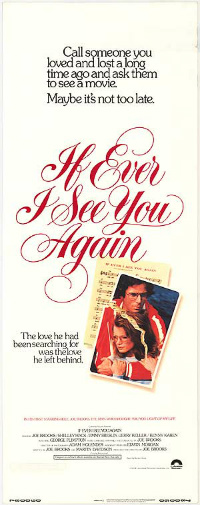
If Ever I See You Again is a 1978 American romantic drama film nearly a composer who rekindles his relationship with a onetime girlfriend. Information technology stars Joe Brooks, who also co-wrote, produced, directed, and scored the film, and Shelley Hack. The picture show'southward theme song, "If E'er I Run into Yous Again", was a moderate hit for Roberta Flack, reaching #24 on the Billboard Hot 100 chart.
Plot [edit]
Bob Morrison is a successful composer of TV commercial jingles who has become rich from his work, allowing him to make a practiced life in New York City for himself and his two young children. Nevertheless, Bob is frustrated with having to accommodate his music to the ideas of executives such every bit Lawrence who are oft eccentric or rude. Bob secretly envies his quondam friend David, who has lived in relative poverty for years while pursuing a career as a classical pianist. David's sacrifices are at present starting to pay off with a concert at Carnegie Hall, and he is as well happily married, while Bob has been a widower for some years (the death of his married woman is strongly implied, although not shown or stated directly). Bob never got over his college girlfriend, Jennifer Corly, who slept with him briefly in college and and so, saying she wasn't ready for a serious delivery, bankrupt up with him and dated another human.
Bob and his assistant Mario travel to Los Angeles for one 24-hour interval to meet two movie producers for whom Bob hopes to score a film. While there, Bob learns that Jennifer is living in Malibu, calls her and visits her at abode soon before he has to get out. Jennifer has become a painter, is still beautiful and unmarried, and seems attracted to Bob, fifty-fifty kissing him goodbye at the aerodrome. Bob falls in dear with her all over again.
Back in New York just earlier Christmas, Bob'due south frustrations lead him to decide with his partner Steve Warner to shut downward their jingle-writing business organization, thus putting Mario out of a chore. Nevertheless, before Bob tin inform Mario, Mario makes a grateful oral communication thanking Bob for all Bob has washed for him, leaving Bob feeling also guilty to speak farther. Bob then learns the producers are seriously considering hiring him, but that they insist he come to Los Angeles to tape music for the final audition. Bob reluctantly agrees to become, although he prefers to work from New York.
Upon arriving, Bob calls Jennifer and invites her to his recording session and to dinner, but she abruptly turns him downward. A down-hearted Bob goes to the studio, just cheers up after David arrives unexpectedly to play piano at his session, and then Jennifer arrives, having inverse her mind. Afterwards, Bob confesses to Jennifer that he composed the love vocal recorded at the session many years agone with her in mind. Bob and Jennifer make love and spend fourth dimension together, but Jennifer breaks upwardly with him again, telling him that although she loves him, she'south "non a forever person" and tin can't modify. As she drives away, Bob learns that he got the motion picture score task and that he will even exist able to piece of work from New York City equally he prefers, pregnant that he will not exist returning to California.
Heartbroken, Bob returns to New York and prepares to celebrate the holidays with his family and friends. While he is hosting a children's Christmas party, Jennifer suddenly appears, having reconsidered the breakup, and Bob and Jennifer happily reunite.
Cast [edit]
- Joe Brooks as Bob Morrison
- Shelley Hack every bit Jennifer Corly
- Jimmy Breslin as Mario Marino
- Jerry Keller as Steve Warner
- George Plimpton as Laurence Lawrence
- Kenny Karen as David Miller
- Caroline Mignini as Laura Miller
- Shannon Bolin equally Elsa
- Danielle Brisebois as Amy Morrison
- Branch Emerson equally Jonathan Morrison
Peter Billingsley, then a child actor who became well known a few years afterward as "Ralphie" in A Christmas Story, made one of his get-go film appearances in the Christmas party scene.
Production [edit]
Brooks fabricated If Ever I See You Again every bit the follow-upwardly to his successful 1977 film, Y'all Light Up My Life, which Brooks had produced, written, directed and scored. Y'all Light Upward My Life was a box office hitting and the title song "Yous Light Upwards My Life" was an even bigger success, setting a new record for well-nigh weeks at #1 on the Hot 100 Chart and winning Brooks an Academy Award for Best Original Song, a Grammy Honor for Song of the Year, and other honors.[i] [2]
Brooks' partner, Robert Chiliad. Lifton, later wrote that he and Brooks set up out to make a similar follow-upwardly, equally financing was likely to be available for a concept that had already been proven successful. In his self-published memoir, Lifton wrote that they "focus[ed] on making depression cost movies with music that could carry the movie and let the record help the flick and the movie help the record." For If Always I See You Again, Brooks and Lifton obtained financing from a friend whose son was seeking a picture show business feel, and were therefore able to make the pic with little financial risk to themselves.[iii] Daily Variety at the time of production reported a budget of start $1.45 meg and later $1.8 million.[4] Film historian Paul Talbot after reported the production budget as $3 million.[5]
In addition to producing, co-writing, directing and scoring the picture show, Brooks also decided to play the leading role of "Bob Morrison" himself.[3] Although the graphic symbol mirrored Brooks' ain life as a rich, successful composer of advertizement jingles who moved into film piece of work, Brooks had no significant acting experience.[1] [vi] Brooks claimed to have spent $20,000 on giving himself ii screen tests to make sure he could play the function and received Columbia Pictures' approval based on the tests.[5] In a New York Times interview while the film was in production, Brooks said, "I really thought I was the best guy to play the lead."[six] According to i columnist, Brooks cast himself in the function later Al Pacino and George Segal both turned it down.[7]
Like Brooks, most of the other main actors were as well inexperienced. Jerry Keller and Kenny Karen were former pop musicians turned jingle creators who had worked with Brooks in the past. Keller's film experience consisted of a bit part in You Calorie-free Upward My Life as an orchestra music manager. Shelley Hack was then a model best known for appearing in a television commercial for Revlon's "Charlie" fragrance, who had a 2-line function in Woody Allen'due south acclaimed moving-picture show Annie Hall.[8] Jimmy Breslin and George Plimpton were primarily known as journalists and authors, although Plimpton had small-scale parts in several previous films.[3] [ix]
Working titles for the film included The Mozart of Madison Avenue and California.[4] Information technology was shot in New York City and Los Angeles during the holiday season of 1977. The cast provided their own wardrobes.[5] Hack, who in real life was nearsighted,[8] wore her own glasses.[five]
According to Daily Diverseness, Columbia spent an boosted $2.five million on promoting the motion picture.[4] In addition to the soundtrack anthology, a paperback novelization of the screenplay was released by Bantam Books in May 1978 every bit a promotional tie-in.[ten] As a further promotional gimmick, Columbia teamed with Pertec Computer to "reunite lost lovers whenever a toll-free number is called" by having a computer match up the details of callers.[4] [11] [12] An editor of Minicomputer News and his secretary posed as former lovers attempting to locate each other to test the service, with somewhat unsuccessful results.[12]
Soundtrack [edit]
| If Ever I See You Once more: Original Pic Soundtrack | |
|---|---|
| Soundtrack album by Joseph Brooks and various artists | |
| Released | May 1978 |
| Recorded | 1978 |
| Studio | A&R Recording Studios New York Metropolis |
| Genre | Pop, Moving-picture show score |
| Label | Warner Bros. |
| Producer | Joseph Brooks |
| Singles from If Ever I See You Again | |
| |
In keeping with the idea of "music that could acquit the movie," Brooks wrote a number of songs for the pic: he also revived for the soundtrack the 1966 Julie Mon regional hit "Come Share the Good Times With Me" with the title adapted to "Come up Share My Love" (Brooks had produced the Julie Monday recording but its songwriting credit had been to Gilbert Kennington a pseudonym for Brooks' brother Gilbert Kaplan: however authorship of "Come up Share My Dear" was credited to Brooks himself). Prior to the moving picture's release, Brooks bundled for Debby Boone, who in the preceding months had accomplished blockbuster success with her debut solo single: her rendition of the theme song from Brooks' first film production You lot Lite Up My Life, to record versions of the title theme "If Ever I Come across Y'all Again", "California", "Come up Share My Honey", "Information technology Was Such a Farewell", and "When It's Over". Boone released "California" in February 1978 equally the follow-upward to "You lot Calorie-free Upwardly My Life", simply "California" only reached #50 on the Hot 100 chart, declining to indistinguishable Boone'southward previous success.[xiii] The versions recorded by Boone were eventually released on her album Midstream (1978).
After the relative failure of Boone's "California", Brooks reached out to Atlantic Records to get Roberta Flack, an established artist with a track record of number ane hits, to record "If E'er I See You Over again".[3] According to Flack, she "couldn't stand" the song and agreed to record information technology only after being pressured past the president of Atlantic and negotiating a "huge money bargain".[14] Flack subsequently recorded versions of the title song besides every bit "Come Share My Beloved" and "When It's Over", all produced by Brooks.
Flack's version of "If Ever I See You Again" was released in April 1978 in preparation for the May 1978 opening of the film. Although the song was a moderate hit, reaching #24 on the Hot 100, #1 on the Billboard Piece of cake Listening chart,[15] and #37 on the R&B chart,[xvi] it failed to match the success of several previous hit singles by Flack, much less the popularity of "You Low-cal Upwardly My Life". The film songs recorded by Flack, including "If Always I Come across You Again", were included on her cocky-titled 1978 album Roberta Flack.
Brooks also recorded the flick's songs for an anthology on Atlantic titled The Joe Brooks Group. [17]
An original soundtrack double album for the film was also released on Warner Bros., which independent instrumental music from the movie, Boone's versions of "California" and "Come Share My Love", and other songs performed by studio musicians including male vocalist Jamie Carr (who sang the theme song in the film). The album did not contain Flack's version of the theme song or any other contributions past Flack.[18]
Track list [edit]
Side 1:
- "If Ever I See You Once more" (Vocal) – Jamie Carr (4:16)
- "California" (Grouping) – Joe Brooks (3:33)
- "Something To Sell" – Joe Brooks (2:12)
- "When It's Over" (Instrumental) – Joe Brooks (3:18)
- "Christmas Song" (Version 2) – Joe Brooks (two:28)
Side 2:
- "When It's Over" (Vocal) – Joe Brooks (3:18)
- "If Ever I See You Once more" (Jennifer'south House) – Joe Brooks (iv:42)
- "Wake Upwards" – Joe Brooks (0:52)
- "Walk To Jennifer's House/California" – Joe Brooks (7:10)
Side 3:
- "Come Share My Beloved" – Joe Brooks (3:xl)
- "EKG Machine" – Joe Brooks (0:41)
- "California" (Slow Instrumental) – Joe Brooks (3:12)
- "If Ever I Come across You Again" (Instrumental) – Joe Brooks (4:sixteen)
- "Christmas Song" (Montage) – Joe Brooks (3:55)
Side 4:
- "California" (Slow Vocal) – Joe Brooks (three:12)
- "When It'southward Over" (Montage) – Joe Brooks (3:18)
- "David'due south Concert" – Kenny Karen (1:57)
- "Boulevard & Backroads" – Joe Brooks (3:05)
- "Come Share My Love" – Debby Boone (3:44)
Reception [edit]
Notwithstanding the moderate success of Flack'due south single, and the considerable effort and toll put into promoting the film, If E'er I See You Once again received generally negative reviews (although the Los Angeles Times praised the "nice, natural quality" of the performances "despite Brooks' stilted direction")[iv] [19] [20] [21] [22] and bombed at the box office.[5] Hack after admitted in an interview that it was "a bomb".[23] Reportedly, it failed to recoup its product budget or even its promotional costs.[5]
Some of the criticism centered on poor interim by Brooks or other members of the inexperienced cast.[19] [20] [22] Breslin and the film were nominated in Harry and Michael Medved'southward 1980 book The Golden Turkey Awards in the category "Worst Acting Performance by a Novelist".[24] Leonard Maltin, who gave it a grade of ane 1/2 stars,[25] stated, "Breslin should stick to his typewriter."
At the 1978 Stinkers Bad Movie Awards, the picture won Worst Picture.[26] When the Stinkers Ballot Expansion Project launched in 2003, the movie received the following notes:
- Worst Film (now a nomination, with Renaldo and Clara being the new winner)
- Worst Sense of Direction for Brooks (nominated)
- Worst Song Or Song Functioning in a Movie or Its Stop Credits for "If Ever I See You Again" by Joe Brooks (nominated)
- Worst Screen Couple for Brooks and Hack (nominated)
- Worst Extra for Hack (dishonourable mention)
- Worst Vocal Or Song Functioning in a Moving-picture show or Its Finish Credits for "California" by Brooks (dishonourable mention)[27]
The film'due south reputation did non meliorate with time. In 2011, an article in New York magazine termed it an "obscure flop".[28]
If Ever I Run across Yous Again was released on VHS in 1986.[5] As of 2015, it had non been released on DVD.
References [edit]
- ^ a b Farber, Stephen (May 1978). "King of Corn". New West: 24.
- ^ Roberts, David (2006). British Hitting Singles & Albums (19th ed.). London: Guinness World Records Limited. p. 136. ISBN1-904994-10-5.
- ^ a b c d Lifton, Robert Thousand. (2012-11-16). An Entrepreneur's Journey: Stories from a Life in Business and Personal Diplomacy. Bloomington, Indiana: AuthorHouse. pp. 197–199. ISBN978-ane-4772-7931-i.
- ^ a b c d e "AFI Itemize of Feature Films: If Ever I Come across Y'all Again". afi.com. American Pic Institute. Archived from the original on 2015-09-16. Retrieved 2015-11-18 .
- ^ a b c d due east f g Talbot, Paul (December 2011). "If Ever I Come across You Once again (1978)". Shock Cinema (41).
- ^ a b Lichtenstein, Grace (1977-12-25). "These Days, Movies Low-cal Up His Life". The New York Times. p. 63. Retrieved 2015-11-17 – via NYTimes.com.
- ^ Sloan, Robin Adams (1978-05-01). "The Gossip Cavalcade: Woody Forbids Mention of Oscars in Motion picture Ads". Garden City Telegram. Garden City, Kansas. p. 12. Retrieved 2015-eleven-15 – via Newspapers.com.
- ^ a b Scott, Vernon (1978-05-28). "Model Hopes to Hack Information technology as an Actress". The Salina Periodical. Salina, Kansas. p. 23. Retrieved 2015-11-18 – via Newspapers.com.
- ^ Buckley, Tom (1978-06-08). "Paramount Picks Up Tab For Rights to New Musical". The Sunday-Telegram. San Bernardino County, California. p. B15. Retrieved 2015-11-15 – via Newspapers.com.
- ^ Stewart, Kerry (May 1978). If Ever I See You Again (paperback ed.). New York City: Runted Books. ISBN978-0553121872.
- ^ "If Always I Encounter You Again". BoxOffice. New York City. May 29, 1978.
- ^ a b Knoblauch, Mary (1978-06-12). "News for You: Sometimes, It Just Doesn't Compute". Chicago Tribune. p. B2.
- ^ Fred Bronson (2003). Billboard's Hottest Hot 100 Hits. Billboard Books. p. 217. ISBN978-0-8230-7738-0.
- ^ Thompson, Carmen Renee (January 2003). "Everything Is Everything". Vibe. New York City: 40. Retrieved 2015-11-15 .
- ^ Whitburn, Joel (2002). Top Adult Gimmicky: 1961-2001. Record Enquiry. p. 93.
- ^ Whitburn, Joel (2004). Superlative R&B/Hip-Hop Singles: 1942-2004. Record Enquiry. p. 207.
- ^ "The Joe Brooks Group". discogs.com. Retrieved 2016-06-xi .
- ^ "If Ever I See Yous Once again (1978)". Soundtrackcollector.com. Archived from the original on 2015-11-18. Retrieved 2015-11-18 .
- ^ a b R.R. Bowker (May 1989). Variety's Film Reviews: 1978-1980. Vol. 15. New Providence, New Bailiwick of jersey: Bowker. ISBN978-0835227957.
- ^ a b Maslin, Janet (1978-05-24). "Pic Review: If E'er I See You lot Again (1978): Pic: Adman'southward Romance". The New York Times. New York City. Retrieved 2015-11-18 .
- ^ Gross, Linda (1978-05-19). "Flick Review: Giving Romance Some other Take a chance". Los Angeles Times. Los Angeles, California. p. H19.
- ^ a b Martin, Judith (1978-05-26). "The Fathers of Necessity". The Washington Post. Washington, D.C. p. 19 (Weekend department).
- ^ Smilgis, Martha (1979-09-24). "Charlie'southward Latest Angel". People . Retrieved 2015-11-18 .
- ^ Medved, Harry; Medved, Michael (1980-04-14). The Golden Turkey Awards: The Worst Achievements in Hollywood History. New York City: Perigee Merchandise. ISBN978-0399504631.
- ^ Maltin, Leonard (2009). Leonard Maltin'south Pic Guide (2009 ed.). New York City: Plume. p. 655. ISBN978-0-452-289789.
- ^ "The Stinkers 1978 Election". Stinkers Bad Movie Awards. Archived from the original on 2 December 1998.
- ^ "STINKERS Ballot EXPANSION PROJECT: 1978". Stinkers Bad Movie Awards. Archived from the original on 10 Baronial 2003. Retrieved 6 September 2019.
- ^ Verini, James (2011-02-05). "The Curious Case of Joseph and Nicholas Brooks". New York. New York City. Retrieved 2015-xi-xv .
External links [edit]
Source: https://en.wikipedia.org/wiki/If_Ever_I_See_You_Again_(film)
0 Response to "If Ever I See You Againroberta Flack"
Post a Comment